
[ad_1]
To mark the three hundredth anniversary of the demise of Christopher Wren—one of many giants of British structure, and creator of London landmarks together with St Paul’s Cathedral and the Royal Hospital Chelsea—the London Design Pageant and Bloomberg Philanthropies have commissioned new mild installations for 2 of his best buildings. Each mild items had been launched with reside demonstrations on the eve of the competition’s opening on 16 September.
Moritz Waldemeyer, the London-based German artist and designer, devised Halo for St Stephen Walbrook (1672), a Metropolis of London church, the place the polymath mathematician-architect Wren performed intriguingly with the massing of squares and circles to assist the primary dome in any British constructing. The church additionally has a large round altar in marble, carved by Henry Moore in 1972, that provides a liturgical centre to the constructing beneath its 20m-high dome.
Pablo Valbuena, the France-based Spanish set up and lightweight artist, in flip created Aura for the regal St Paul’s, for which Wren wowed King Charles II with an early scheme in the identical yr that St Stephen’s was accomplished. The cathedral—the place Wren the scientist labored out his preoccupations with mild and acoustics on a grand scale—was accomplished in 1710, with its well-known dome supported by a lofty, arched nave and transept.
Halo: a pendulum’s conical swing
Waldemeyer’s Halo consists of an 8kg brass weight within the saucer-like type of an elegantly flattened sphere and a 20m twine from which the mass hangs, to create a rotating pendulum hooked up to the lantern of Wren’s dome. The conical swing of the pendulum, sweeping low and sluggish, simply centimetres above the rim of Moore’s adamantine altar, has a frequency of 8.4 seconds per circuit, one which generates a continuing mild (via circuitry fitted within the brass weight) that strikes evenly up and down the twine, generated by a sequence of light-emitting diodes (LEDs).
The titular halo will not be seen to the bare eye. Waldemeyer, who educated as an engineer, devised the frequency of the pendulum’s swing in order that the halo would seem (tilted at an angle due to the cellular mild supply) in photos taken utilizing long-exposure images whose period matched the frequency of the pendulum’s conical “swing”.
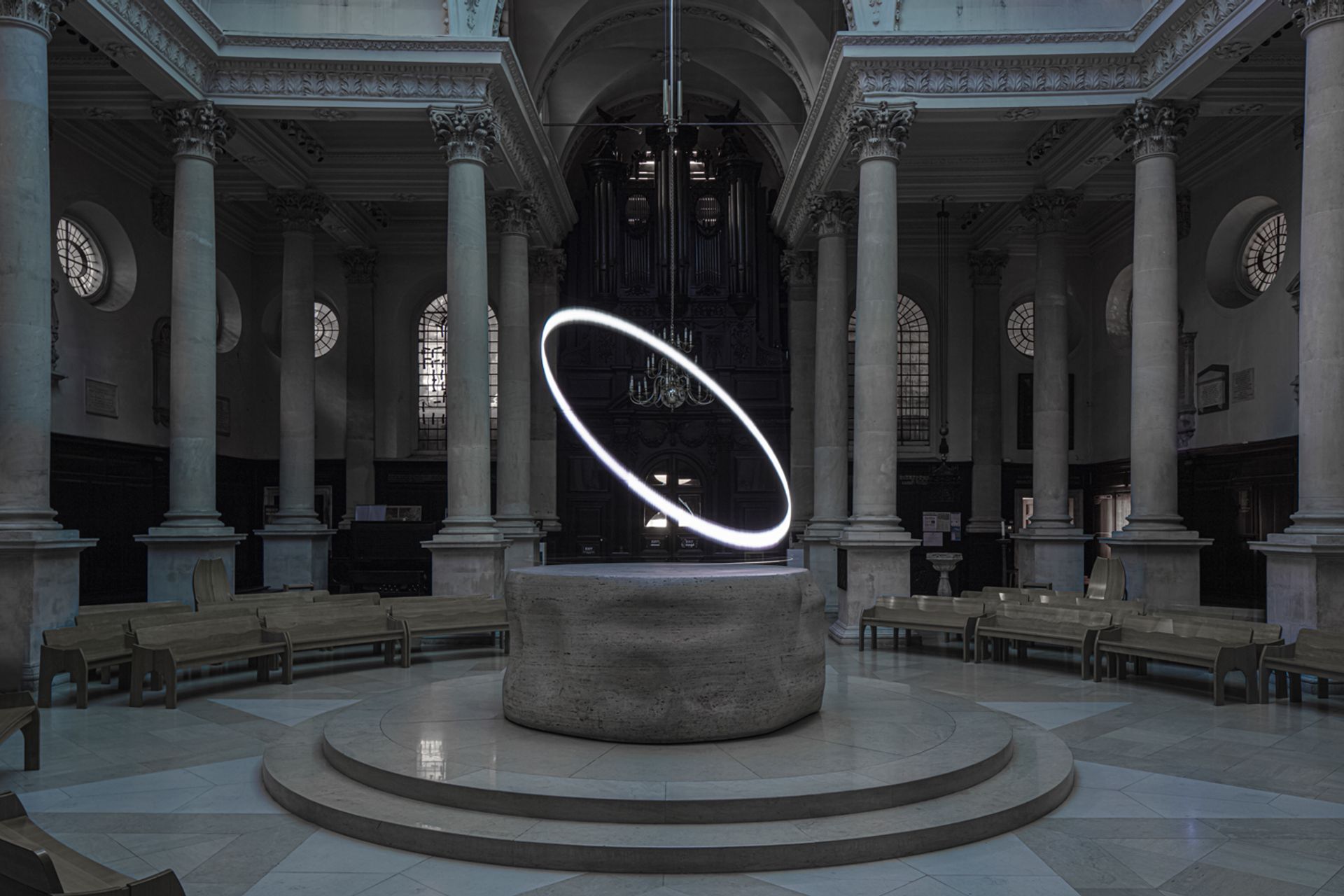
Moritz Waldemeyer’s Halo at St Stephen Walbrook, London. The tilted halo type is captured utilizing long-exposure images to match the 8.4-second frequency with which an illuminated pendulum rotates above the rim of Henry Moore’s marble altar London Design Pageant. Supported by Bloomberg Philanthropies. {Photograph} © Ed Reeve
Waldemeyer desires experiencing Halo to be “a meditative second”, he tells The Artwork Newspaper. “To have a look at it and neglect about time and area.” So as to add to the contemplative side of his halo-generating pendulum, Waldemeyer initiatives slowly paced astral patterns onto the coffered dome of St Stephen’s, from projectors positioned on the bottom ground bases of the pillars that assist the dome. He was impressed to make this, drawing on the aurora borealis and the photo voltaic flares on the corona of the solar, by Wren’s curiosity in astronomy.
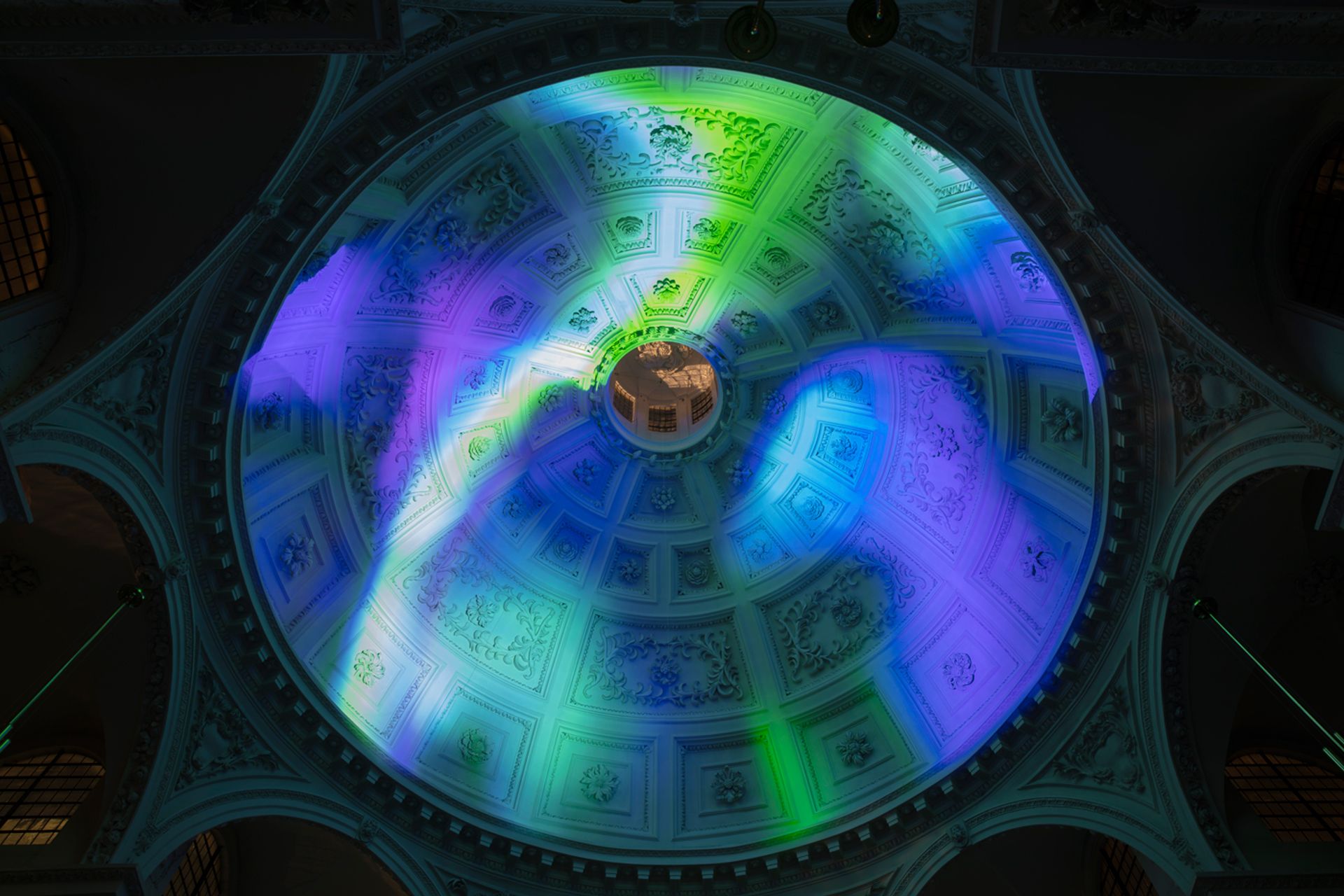
Moritz Waldemeyer’s Halo at St Stephen Walbrook, London. The slowly transferring projection of astral our bodies into the church’s dome is designed by Waldemeyer as a tribute to Christopher Wren’s curiosity in astronomy, and as a part of Halo’s meditative character London Design Pageant. Supported by Bloomberg Philanthropies. {Photograph} © Ed Reeve
He devised each parts of Halo after spending time on the church, and was drawn to the central dome and its peak. The 20m ceiling of the dome gave him the peak he wanted to hold a pendulum, one with a stately, meditative tempo of rotation. By means of his immersion with the constructing, Waldemeyer feels he has received to know Wren the polymath scientist, mathematician, thinker and pupil of optics. And to admire Wren’s use of daylight to enliven the structure of his tightly wrought interiors.
For influences, Waldemeyer appears to be like again to Thomas Edison (1847-1931), inventor of the lightbulb, and, extra straight, to the late industrial designer Ingo Maurer (1932-2019), who collaborated with Waldemeyer on his redesign of the candle for My New Flame, launched at Maurer’s Milan present in 2012, the place Waldemeyer used 128 LEDs to recreate the impact of a single flame. Maurer, Waldemeyer says, was “the inventor of the playful tackle mild design that we now take with no consideration”.
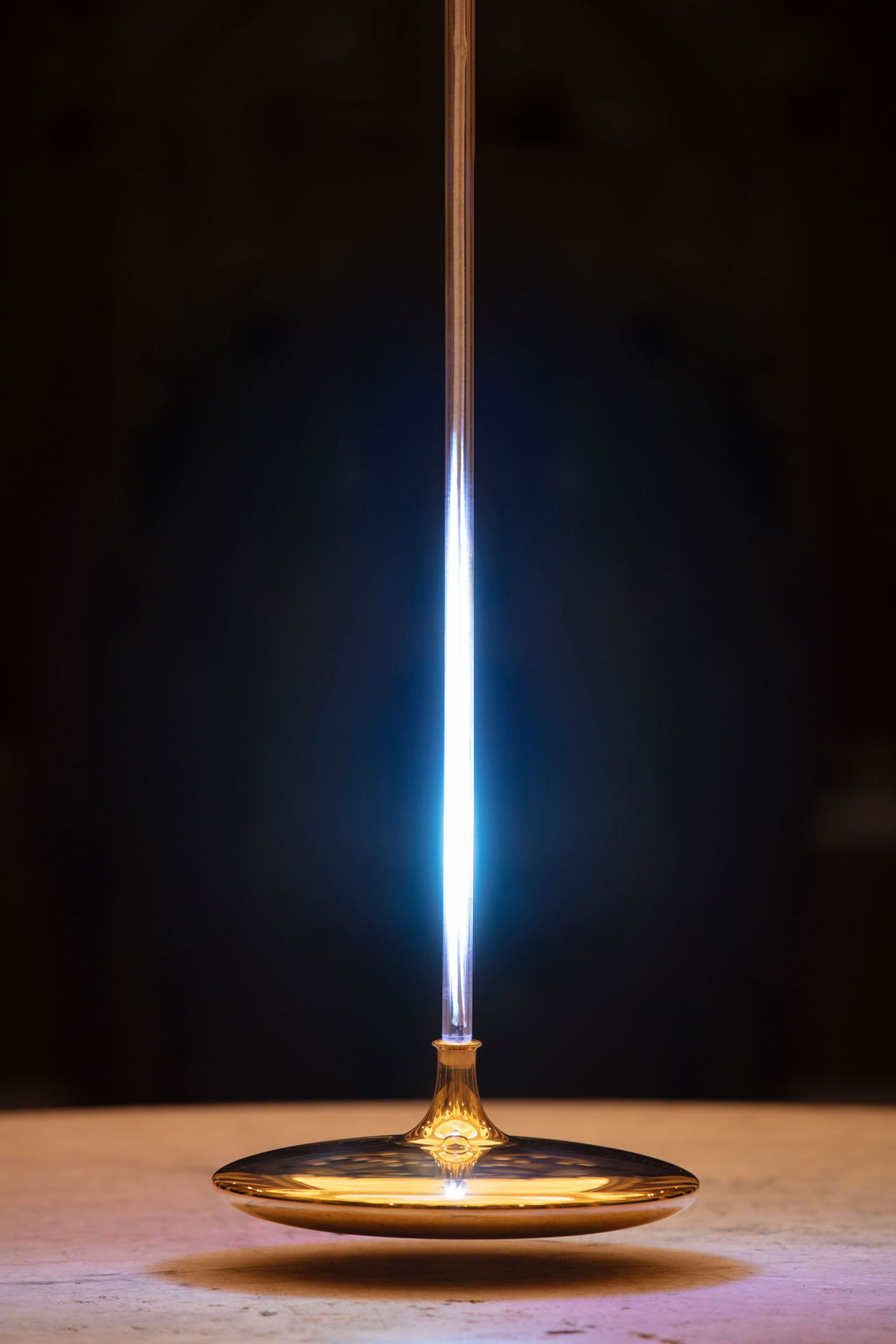
Moritz Waldemeyer’s Halo at St Stephen Walbrook, London London Design Pageant. Supported by Bloomberg Philanthropies. {Photograph}: © Ed Reeve
“I began out within the early 2000s,” Waldemeyer says. “The time that LEDs began this unimaginable journey from being an indicator mild in your stereo to be an precise technique of illumination.” An LED is an digital part, one which works nicely, he explains, with a programmable controller and programming: “[This] provides rise to infinite quantities of creativity… By writing code you possibly can create mild results that weren’t attainable beforehand.” For Halo he used a comparatively new LED strip known as COB (Chip on Board), “the place they put the one LEDs so shut collectively, and encased in a single extrusion, a silicon, in order that it appears to be like like neon”.
“Concepts that enchantment on an emotional degree,” he says. “That’s the key mixture that attracts me down this rabbit gap. To make stunning issues which might be emotionally interesting; that use mild based mostly on the tech that has developed over the previous 20 years.”
Aura: mild built-in with sound
For Pablo Valbuena the main target in making ready Aura was to immerse himself within the construction and every day functioning of St Paul’s, and Wren’s considering behind his masterpiece, for days earlier than contemplating the character of the piece he would make. Like Waldemeyer at St Stephen, Valbuena was drawn to the dome, the constructing’s focus each externally and internally.
Valbuena, who educated in structure, had beforehand studied Wren’s strategy to the catenary—the form created by a dangling rope or chain—which, when inverted, types the perfect profile for a structurally sound dome. (A few of Wren’s drawings and calculations for the structural function of the central part of his triple dome are within the assortment of the British Museum.)
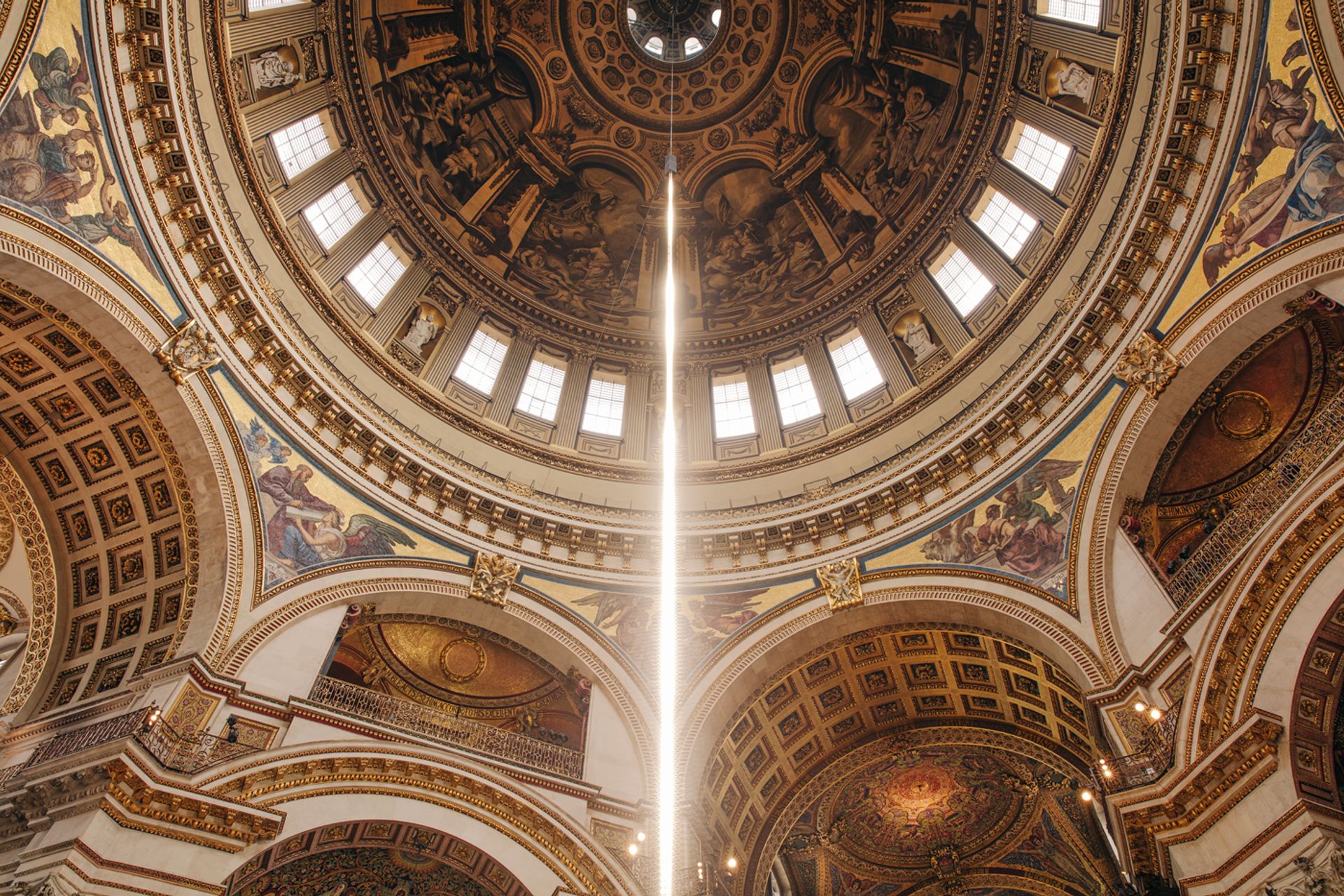
Pablo Valbuena’s Aura hangs from the oculus on the high of the inside dome of St Paul’s Cathedral, in London London Design Pageant. Supported by Bloomberg Philanthropies. {Photograph}: © Ed Reeve
He spent three days getting to grasp the constructing and its rituals: the every day liturgy and the contrasting durations of peak vacationer customer numbers. He discovered the research of concept—and of Wren’s work on the Sheldonian Theatre, Oxford, the place Wren developed lots of the rules he deployed later in his London church buildings—served as a complement to the times spent experiencing the constructing and its every day ecclesiastical life. “You’ll be able to know theoretical points of [a] constructing, however I’d by no means make a bit [without visiting the location first],“ he tells The Artwork Newspaper. “The very first thing I demand is to go there and make investments time.”
Aura is suspended by a twine from the towering oculus on the centre of the cathedral’s inside dome. The sunshine sources, a sequence of tons of of custom-made LEDs, are held on a pencil-thin aluminium body, 20m tall.
“For me, the usage of tech is attention-grabbing,” Valbuena says. “Am I allowed to talk from a extra up to date mode to questions which have been requested all through human historical past? [But I am] not within the devices, or the novelty or the wow issue of a brand new expertise.”
“I attempt to use probably the most easy, the best method to do it with the obtainable expertise,” he says. “We do unusual issues. We’ve to plan our personal {custom} software program, our personal {custom} lights. Nevertheless it doesn’t imply that it’s [technologically] leading edge.” Valbuena labored on Aura with Artichoke, the humanities manufacturing firm specialising in public artwork, and with native rigging and sound firms. His crew included two technical administrators, one specializing in design, electronics and {hardware}, and one other dedicated to the technical set up.
“We designed one thing very mild, very materials,” Valbuena says. The entire 20m construction weighs 100kg. ”In most of my initiatives I’m eager about [working] with just a little quantity of matter, [little] weight. If you concentrate on [Richard] Serra or Moore, the sculptures are huge. I’m eager about working in a manner that’s rooted within the digital, however making use of [it] to bodily areas. How, with as little matter [as possible], you possibly can rework [a space].”
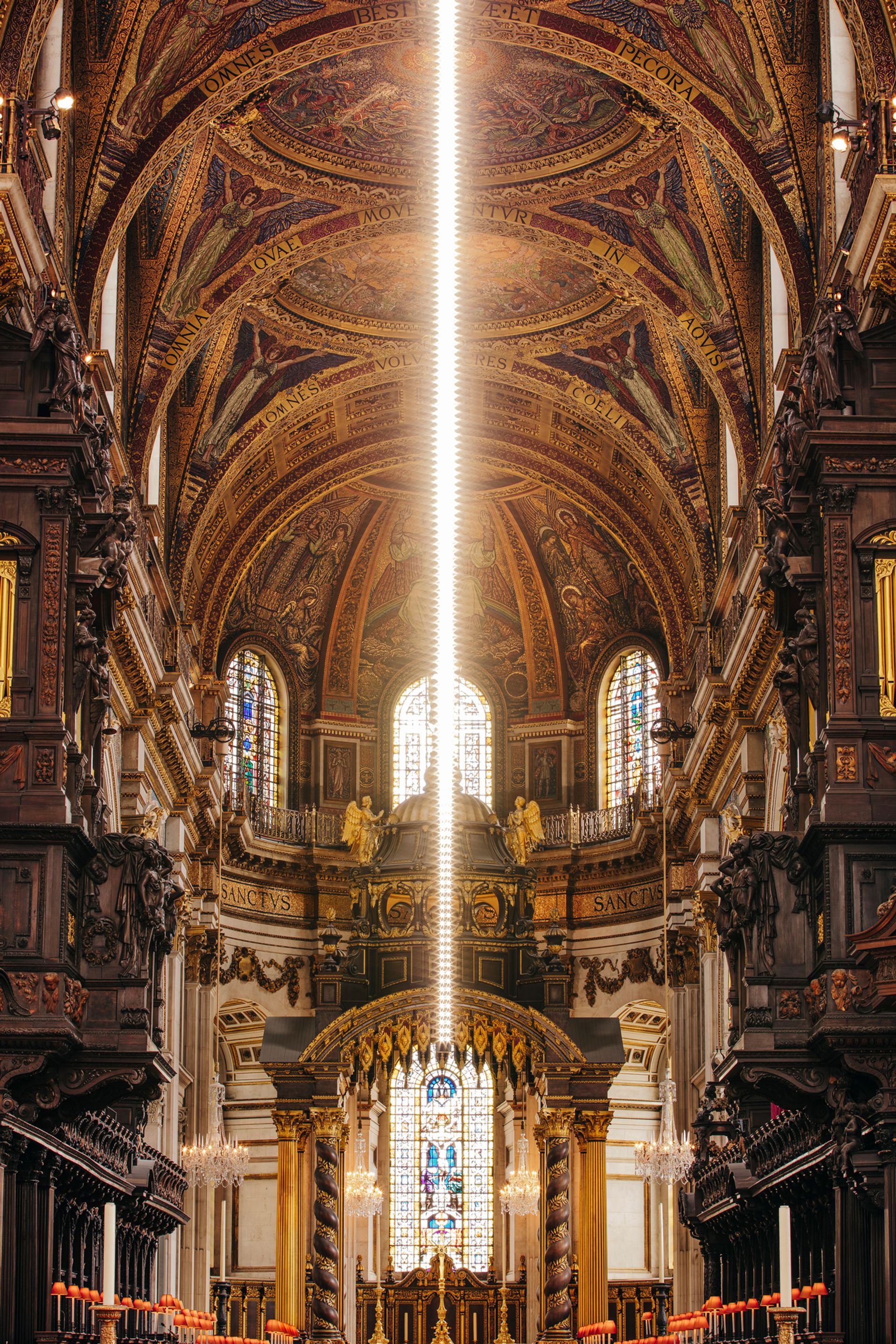
Pablo Valbuena’s Aura seen from the nave of St Paul’s Cathedral, with the backdrop of the choir’s home windows and ceiling London Design Pageant. Supported by Bloomberg Philanthropies. {Photograph}: © Ed Reeve
The sunshine piece in Aura is activated by sound, utilizing an algorithm devised from scratch by Valbuena’s crew. The audio is captured by the cathedral’s personal microphones, which choose up the spoken phrases, whereas further gadgets had been used to seize the singing of the choir or positioned within the organ pipes to catch the complicated, reverberant, notes of that mighty instrument.
Because the sound varies in pitch, quantity and depth, so the patterns of sunshine generated by Aura change. The upper the pitch the upper the sunshine glows on the work’s body. The larger the quantity or depth, the brighter and denser the sunshine that Aura emits.
Within the first public demonstration of Aura, William Fox, the appearing organist and assistant director of music at St Paul’s, performed three items, beginning with J.S. Bach’s Prelude in E Minor. The separation of the sunshine patterns proved satisfactorily mathematical and wide-ranging, with the sunshine patterns matching the broad chord construction, and the even-tempered work of this most mathematical of composers. Aura rippled with broad good explosions of sunshine because the bass drone pipe reduce in. In later items, the piece glowed expansively and brightly because the organist known as on a number of registers directly.
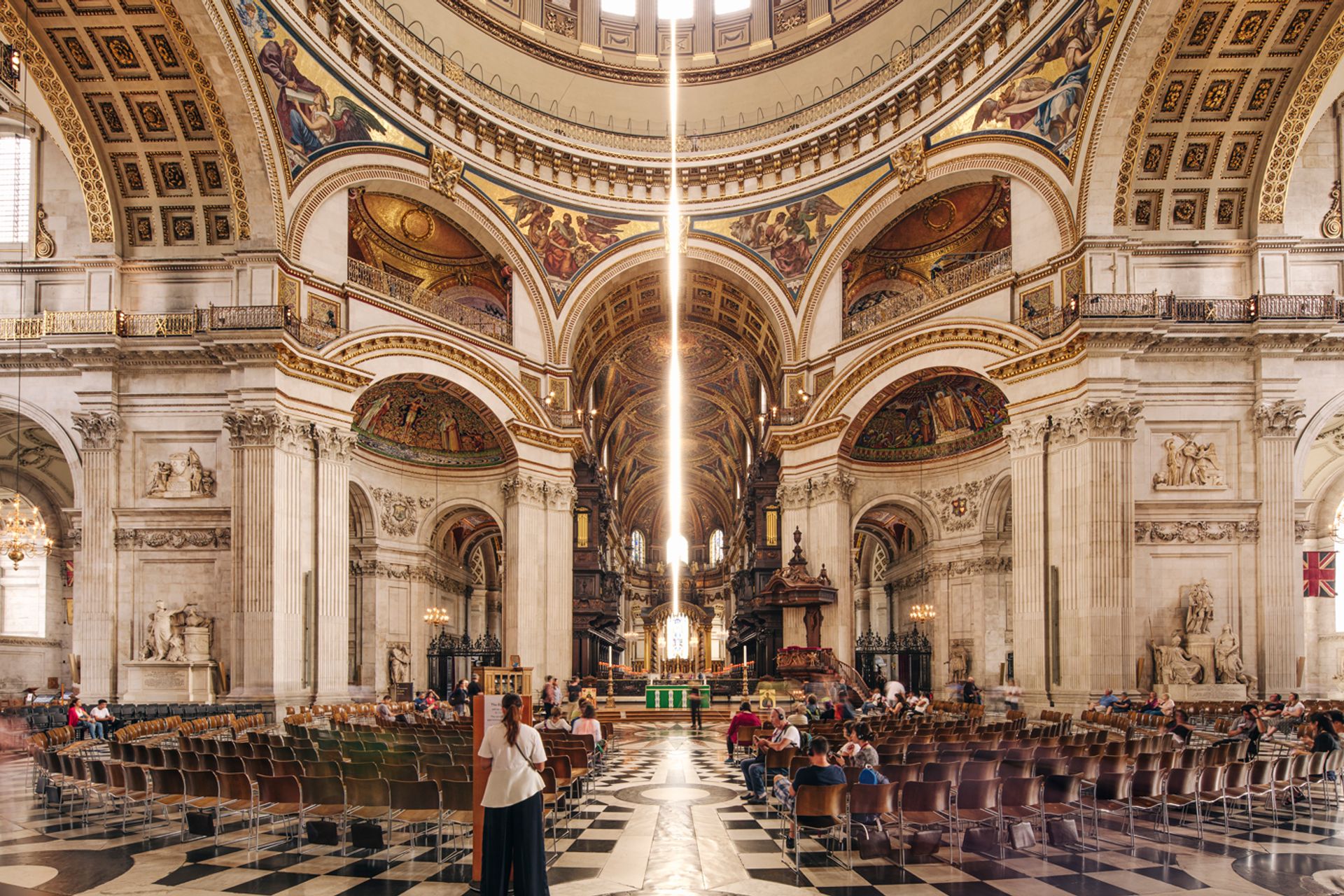
Pablo Valbuena’s 20-metre lengthy Aura, which hangs nearly all the way down to the ground of transept, seen from the nave of St Paul’s Cathedraln London Design Pageant. Supported by Bloomberg Philanthropies. {Photograph}: © Ed Reeve
Valbuena had met his need to create a bit that interacts intently with the cathedral, its liturgical course of, and the mind and spirit of its creator. In the course of the London Design Pageant, guests will get one of the best likelihood of sensing that high quality of interplay, he says, with out cost, on the cathedral’s Evensong, at 5pm every day.
London Design Pageant, till 24 September, varied places all through London
[ad_2]
Source link


